
Written by: MSQ Editorial Team | Reviewed by: MSQ Oil & Gas Sector Specialist | Updated: May 2026
About: MSQ Trading Contracting & Services WLL has over 15 years of operational experience supplying certified oil & gas manpower to Qatar’s most demanding projects — Ras Laffan, Mesaieed, Dukhan, and offshore operations. All content is written by practitioners, not generalists.
Qatar’s oil & gas sector is unforgiving of manpower errors. An uncertified rigger causes an illegal lift. A welder without valid ASME coding causes weld rejections worth QAR 30,000–150,000 in NDT and rework. A worker without current QHSE training is turned away at the Ras Laffan gate and triggers a shutdown schedule delay. After 15 years of supplying certified oil & gas manpower to Qatar’s most demanding projects, MSQ Trading Contracting & Services WLL has seen every manpower mistake — and the real cost when they happen.
Quick Answer: What are the most common oil & gas manpower mistakes in Qatar?
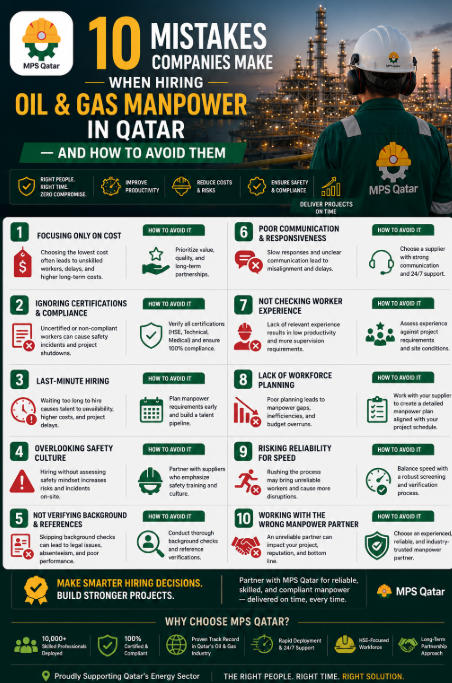
The 10 most costly oil & gas manpower mistakes in Qatar are: accepting certifications without independent verification, ignoring H2S/BA requirements, choosing price over compliance, using general manpower suppliers for specialist O&G roles, underestimating certification expiry management, failing to plan for worker replacement, ignoring WPS payroll compliance, underestimating RLIC gate pass timelines, accepting employer-issued certifications for rigging, and not demanding documented case studies from suppliers.
🚀 Avoid Every One of These Mistakes — Get Certified O&G Manpower From MSQ Today
Mistake 1 — Accepting Certifications Without Independent Verification
The most common and most costly mistake. A worker presents a QHSE certificate, an ASME welding qualification, or a TUV rigging certificate — and it is accepted at face value. In Qatar’s manpower market, certificate fraud is real. Expired certifications are presented as current. Invalid qualifications are submitted for roles they do not cover. MSQ verifies every certification against the issuing body’s records before any worker is deployed. Workers whose certificates cannot be independently verified are not sent to site. Ever.
⚠️ Real cost: A fraudulent ASME welding certificate discovered after weld radiography means rejected welds, rework, re-NDT, and programme delay — typical cost QAR 50,000–200,000 per incident.
Mistake 2 — Ignoring H2S/BA Requirements Until Gate Access Is Denied
Many companies assume H2S/BA training is only required for specific roles — operators or confined space workers, for example. At Ras Laffan and most Mesaieed facilities, H2S/BA is required for every worker without exception. A worker turned away at the RLIC gate for missing H2S/BA certification causes a half-day delay minimum — and a delay that triggers contract penalty clauses in most Qatar oil & gas contracts.
⚠️ Real cost: Standard Qatar O&G contracts carry penalty clauses of QAR 5,000–50,000 per day for schedule failures. One worker turned away at the gate can cascade into a full crew delay.
Mistake 3 — Choosing the Cheapest Supplier Over the Most Compliant
Informal or non-certified manpower suppliers consistently undercut professional ISO-certified suppliers on headline rates. They can do this because they skip certification verification, skip medical testing, skip WPS payroll enrollment, and skip trade testing. The cost saving on the day rate is entirely eliminated — and then some — by the first compliance incident, weld rejection, or site access denial.
💡 MSQ’s Advice: Total deployment cost includes the headline rate plus all the things a cheap supplier leaves out. When you add certification verification, QHSE renewal, medical costs, WPS payroll setup, and the first replacement, ISO-certified suppliers like MSQ are consistently cheaper in total.
Mistake 4 — Using General Manpower Suppliers for Specialist Oil & Gas Roles
General manpower suppliers — companies that supply construction labourers, hospitality staff, and oil & gas technicians from the same database — typically lack the sector knowledge to identify whether a worker’s certification genuinely covers the role they are being deployed for. A general supplier sending a ‘rigger’ to Ras Laffan may not know the difference between TUV Level I and Level III, or whether OPITO Stage 1 is sufficient for a complex multi-crane lift. MSQ’s oil & gas division operates with specialist sector knowledge — verifying certifications to the specific standard the project requires, not just the job title.
Mistake 5 — Failing to Track Certification Expiry During Long-Term Contracts
QHSE certificates are typically valid for 3 years. H2S/BA for 3 years. TUV/DNV rigging certifications for 2 years. OPITO Stage 3 for 2 years. On a 12-month or 24-month oil & gas maintenance contract, workers’ certifications will expire during the contract period. Companies that do not actively track expiry dates face the sudden discovery that multiple workers cannot legally access the site — at exactly the point their skills are most needed. MSQ tracks every deployed worker’s certification expiry and initiates renewal before the certificate expires — for all long-term contracts, at MSQ’s cost.
Mistake 6 — Not Having a Replacement Plan Before You Need It
Worker attrition is a reality on Qatar oil & gas projects. Workers return home for family reasons, better offers arise, medical issues occur. Companies without a pre-agreed replacement mechanism face the same sourcing and certification challenge they faced on the original deployment — but this time under programme pressure. MSQ’s replacement guarantee — like-for-like, no additional placement cost, sourced from our pre-screened Qatar pool — means replacement happens within 48–72 hours, not 4–6 weeks.
Mistake 7 — Ignoring WPS Payroll Compliance
Qatar’s Wage Protection System requires all workers to be enrolled in WPS and paid on time through verified electronic channels. Non-WPS-compliant payroll exposes the employer — and in some cases, the client company — to Ministry of Labour investigation. MSQ enrolls every deployed worker in WPS and manages payroll on time, every pay cycle. Non-compliance simply does not happen on MSQ deployments.
Mistake 8 — Underestimating RLIC Gate Pass Lead Times
Companies planning Ras Laffan deployments who have not worked at RLIC before consistently underestimate gate pass lead times. New RLIC gate pass applications typically take 2–4 weeks — sometimes longer during high-activity periods. Planning a 200-worker shutdown mobilisation with 1 week’s notice and no gate-pass-holding workers in the pool is a recipe for delay. MSQ’s Qatar-based workforce pool includes workers who already hold valid RLIC gate passes — enabling same-day or next-day Ras Laffan deployment for these workers.
Mistake 9 — Accepting Employer-Issued Rigging Certificates
Some manpower suppliers supply riggers with ‘rigging certificates’ issued by previous employers or internal training departments. These are not third-party certifications. They cannot be independently verified. And in Qatar’s oil & gas sector, where a rigging failure can cause fatalities and multi-million riyal equipment damage, they are not acceptable. MSQ supplies riggers with TUV SÜD, DNV, or OPITO certification only — independently verified before every deployment.
Mistake 10 — Not Demanding Documented Case Studies From Suppliers
Every manpower supplier in Qatar claims to be ‘experienced’, ‘trusted’, ‘reliable’, and ‘quality-focused’. The only way to distinguish genuine capability from marketing is to demand documented case studies — with specific numbers, timelines, and client-verifiable outcomes. MSQ’s case studies are documented and client-verified — 150 workers at Ras Laffan in 48 hours, 20 instrument technicians at Mesaieed in 2 weeks, HSE officers at Dukhan for 12-month AMC contracts. If a supplier cannot provide this level of specific evidence, their claims are unverified.
Proven Deployments: MSQ Oil & Gas Manpower in Action
⚠️ Qatar’s oil & gas sector has zero tolerance for under-qualified workers. Every MSQ deployment is third-party certified and verified before site access.
🏆 Case Study — 150 Workers in 48 Hours — Ras Laffan LNG Shutdown
A major EPC contractor at Ras Laffan Industrial City required 150 skilled workers for a critical shutdown and turnaround — covering process technicians, pipe fitters, welders, riggers, and HSE officers. The deadline was non-negotiable: a single day of delay would trigger significant contract penalty clauses. MSQ mobilised the full crew of 150 within 48 hours — every worker QHSE inducted, H2S/BA trained, trade-tested, and fully documented with a valid QID. The shutdown completed on schedule with zero QHSE incidents and zero compliance failures. The client has since awarded MSQ preferred supplier status for all future Ras Laffan campaigns.
🏆 Case Study — 20 Instrument Technicians — Mesaieed Petrochemical Plant
A petrochemical facility operator at Mesaieed required 20 instrument technicians with documented experience in process analysers, field instruments, and distributed control systems (DCS) for a plant modification project. MSQ sourced, verified, and deployed all 20 technicians within two weeks — each holding QHSE certification, H2S/BA training, and documented instrument calibration and maintenance experience. The plant modification programme was completed on schedule with zero instrumentation-related incidents.
🏆 Case Study — HSE Officers for Long-Term O&G Maintenance Contract — Dukhan
An onshore oil field operator at Dukhan required 6 NEBOSH-certified HSE officers for a 12-month extendable maintenance contract. MSQ supplied 6 officers — all NEBOSH IGC certified, current QHSE trained, and experienced in oil & gas site safety monitoring, PTW management, and toolbox talk delivery. The client reported zero lost-time incidents across the first contract year.
✅ MSQ Track Record: 15+ years supplying certified oil & gas manpower to Qatar’s most demanding EPC contractors, plant operators, and field maintenance companies. Zero documented compliance failures on long-term O&G contracts.
Frequently Asked Questions — Oil & Gas Manpower Mistakes Qatar
❓ What is the typical penalty clause value in Qatar O&G contracts for manpower shortfalls?
✅ Based on MSQ’s experience across Qatar oil & gas and EPC contracts, delay penalty clauses typically range from QAR 5,000 to QAR 50,000 per day depending on project scale and contract terms. For major LNG train construction contracts, daily penalties can exceed QAR 100,000.
❓ How often do certification fraud incidents occur in Qatar’s manpower market?
✅ MSQ encounters fraudulent or invalid certification claims during our screening process regularly — particularly for QHSE, H2S/BA, and trade certifications. Independent verification (checking against the issuing body’s records) is the only reliable protection.
❓ What is the most common cause of worker gate denial at Ras Laffan?
✅ Based on MSQ’s 15 years of Ras Laffan deployments, the most common causes of worker gate denial are: expired QHSE training (most common), missing or expired H2S/BA certification, and invalid or expired RLIC gate pass.
Related Manpower Services
→ Welder Manpower Supplier in Qatar
→ Pipe Fitter Manpower Supplier in Qatar
→ Rigger Manpower Supplier in Qatar
→ HSE Officer Supply Company in Qatar
→ Shutdown Manpower Supplier in Qatar
→ Construction Manpower Supply in Qatar
Avoid Every One of These Mistakes — Work With MSQ
MSQ Trading Contracting & Services WLL has eliminated every one of these mistakes from its deployment process through 15 years of Qatar oil & gas experience, ISO-certified quality management, and independent certification verification.
📞 Hire Certified Oil & Gas Manpower in Qatar — MSQ Trading Contracting & Services WLL
Phone: +974 71900472 | +974 71210908
Email: info@manpowersupplyinqatar.com | Website: manpowersupplyinqatar.com
🚀 Avoid Costly O&G Manpower Mistakes — Get Certified Workers From MSQ Today